A Stellar Upgrade: Crafting the Ultimate Starfield Shattered Space PC in 2026
Alex stared at the loading screen, fingers drumming on his desk. It was early 2026, and the buzz around Starfield: Shattered Space had barely cooled. Two years after its release, House Va'ruun's hidden homeworld still pulled explorers into its crimson-hued depths. But his trusty old rig wheezed every time the nebula shifted on screen. Time for an overhaul.
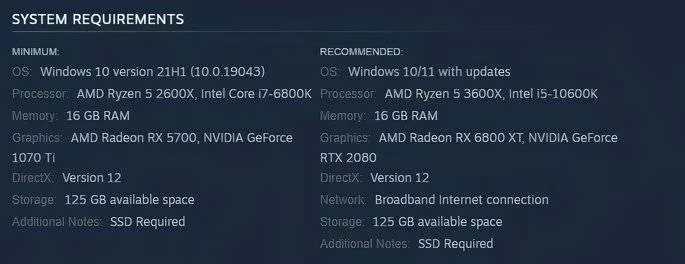
He wasn’t alone. With the DLC demanding the same hefty specs as the base game—no breaks there—many players found themselves in the same space-dust bowl. The hardware requirements hadn’t budged since 2024, but the yearning for smooth frame rates and quick warps had only grown. Alex dug into community forums, sipping his lukewarm coffee, and stumbled upon a trio of battle-tested builds that promised to turn his stuttering ship into a sleek cruiser.
The first thing he learned? Storage was no joke. Starfield had always been a beast, demanding a solid-state drive with room to breathe. The DLC’s preload added another 12GB on top of the base game’s 125GB—plus a day-one patch, because of course. The golden rule floating around was to keep at least 150GB free. Alex winced, deleting a few dusty save files from his drive. “Better safe than sorry,” he muttered, a classic English understatement.
The Entry-Level Path: Budget-Friendly Cosmos
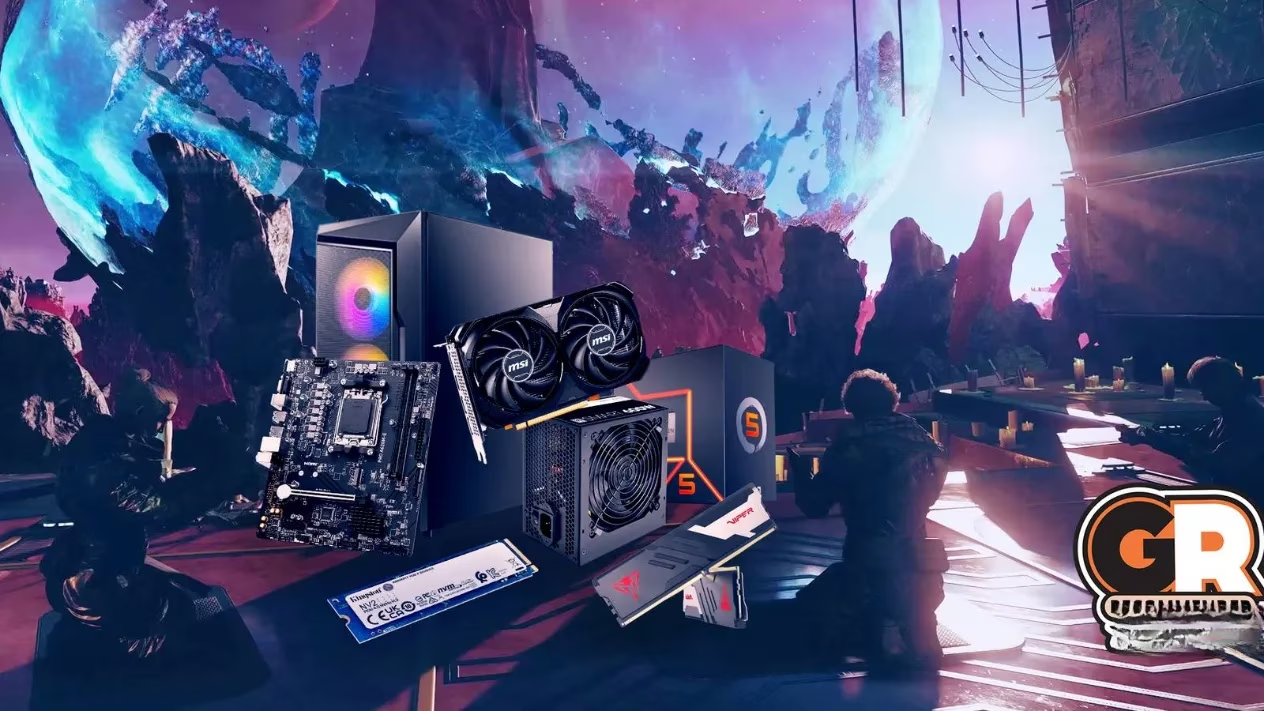
For gamers counting their credits, the entry-level build was a godsend. It centered on the AMD Ryzen 5 7600—complete with its own stock cooler, which was a real penny-saver—and an MSI RTX 4060. Paired with 16GB of Patriot DDR5 RAM and a humble 600W Thermaltake PSU, it kept costs close to the bone without turning the game into a slideshow. An Antec AX61 case housed everything, and while it felt like a splurge on such a tight budget, it delivered bang for the buck. Alex pictured a friend who just wanted to dip their toes in, playing at 1080p or 1440p without breaking the piggy bank. He scribbled a note: MSI Pro A620M-E motherboard, Kingston PCI-E 4.0 SSD—cheap and cheerful.
But Alex had bigger ambitions. He wanted to soar, not just shuffle.
The Mid-Range Sweet Spot: Hitting the Bullseye
This build was the community darling, the "Goldilocks" option that wasn't too hot or too cold. It married the AMD Ryzen 7 7800X3D with Nvidia’s RTX 4070 SUPER in an ASUS Dual trim—a match made in silicon heaven. The 7800X3D’s 3D V-Cache worked wonders on Starfield’s vast planetary loads, while the 4070 SUPER chewed through visuals at QHD like a starving space worm. Cooling was handled by a Cooler Master MasterLiquid 360L AIO, snug inside a Lian Li Lancool 216 case that pushed air like a jet engine.
Memory-wise, 32GB of G.Skill Trident Z5 Neo RAM running at 6000 MT/s with CL30 timings was the secret sauce—tight latencies made AMD’s Zen 4 architecture sing. A 1TB Samsung 990 Pro SSD served as the launchpad, its read speeds making loading screens vanish before Alex could say “grav jump.” The NZXT N7 B650E motherboard kept everything connected with Wi-Fi 6E and a slick black (or white) aesthetic, matching the XPG Core Reactor gold-rated PSU that left headroom for a future RTX 4080 SUPER upgrade. He could almost hear the credits ching-ing in his wallet.
The High-End Heavyweight: No Compromise
Then there was the beast. For those who ate frames for breakfast, this build flexed an Intel Core i9 14900KF—a CPU that screamed “full throttle” in Starfield’s engine—paired with AMD’s Radeon RX 7900XTX from XFX. Cooling that volcanic Intel chip required the ASUS ROG Ryujinn III AIO, an expensive but stunning piece of kit that matched the ASUS ROG Strix Z790-A motherboard like chips and gravy. 32GB of Corsair Dominator Titanium RAM at a blistering 7200MHz XMP speed and a 2TB Crucial T700 PCI-E 5.0 SSD pushed storage into the stratosphere. An MSI MPG A1000G PSU offered enough juice to power a small colony, and the Fractal Design North case in Chalk White wrapped it all in Scandinavian elegance. Alex grinned imagining a white-themed PC that would look right at home on a penthouse desk—provided one was willing to shell out an extra $100 for ASROCK’s color-matched GPU. He whistled. “Now that’s a ship to turn heads.”
The Ace in the Hole: Game Pass and Premium Perks
While the hardware decisions simmered, Alex remembered another sweetener: if you were an Xbox Game Pass subscriber, you could snag the $30 DLC for 10% off on the Microsoft Store. The same price held on Steam, but every penny counted. Some players had already grabbed the Premium Upgrade DLC from launch, netting the Constellation Skin Pack—Equinox Laser Rifle, spacesuit, helmet, and boost pack—along with the digital artbook and soundtrack. A bit of cosmetic seasoning for the deep-space adventurer.
After weighing his options, Alex pulled the trigger on the mid-range build. It was the cat’s pajamas: powerful enough to handle Shattered Space’s sprawling vistas at silky frame rates, yet not so extravagant that his bank account would mutiny. He ordered the parts and spent a rainy Saturday assembling them, the familiar click of RAM slots and the hum of fresh fans filling his room. When he finally booted up the game on his new rig, the galaxy unfolded like never before—crisp, responsive, and utterly immersive. As Va’runn’kai’s ghostly citadel rose on the horizon, he leaned back and smiled. The upgrade had cost him some sweat and a modest stack of cash, but the journey was just beginning. In space, no one can hear you sigh with satisfaction. But Alex did anyway.
For those still on the fence, the lesson was clear: whether you go budget or ballistic, matching your rig to the stars makes all the difference. As they say across the pond, “penny wise, pound foolish” doesn’t fly when a vortex is tearing reality apart. Choose wisely, and revel in the void.