Alchiba: The Outlying Starfield System Rich in Resources and Black Sand Wonders
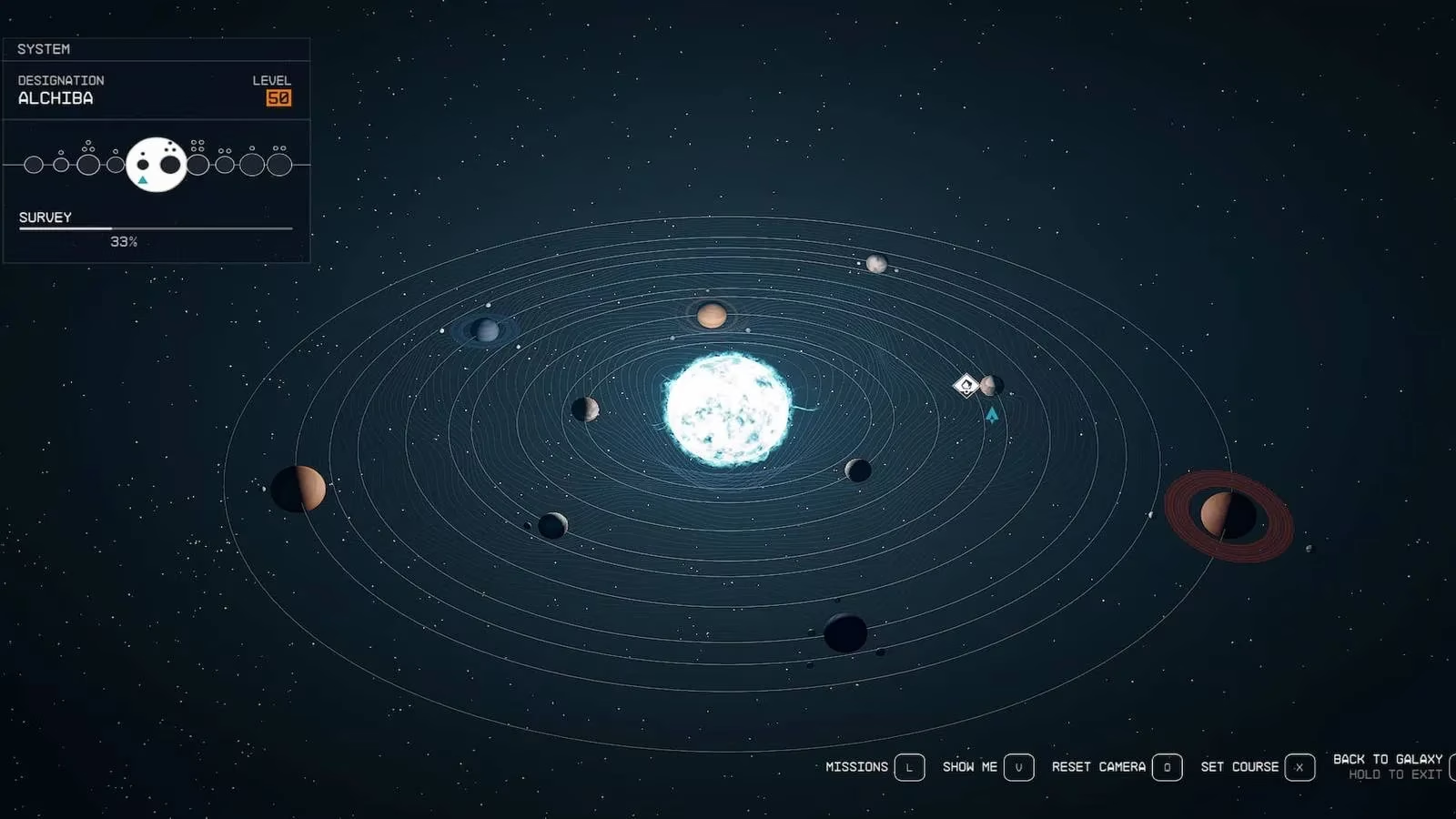
The galaxy of Starfield is vast, and while faction battles and main storylines pull pilots toward familiar hubs like Alpha Centauri or Volii, some of the most rewarding destinations sit quietly on the fringes. Alchiba is one such system—unaffiliated, distant, and yet brimming with possibilities that seasoned explorers in 2026 are only beginning to fully appreciate. Why should a system with no major quest markers demand your attention? What makes its ten planets and eighteen moons worth the grav jump? The answers involve rare landscape features, a wealth of resources, and a chance to build outposts on terrain few will ever see.
Finding Alchiba requires a deliberate route because it hangs near the bottom center of the starmap, well away from bustling trade lanes. Start from the Alpha Centauri system and set course downward and leftward to Olympus, then continue to Volii. From Volii, jump to Bolivar, then look toward the lower edge of the map. Alchiba sits there, isolated—practically a loner among the star clusters. Zooming out fully on your navigation console helps reveal its position, and it is recommended only for pilots level 50 and above. Casual visitors rarely stumble upon it; only those who study the cartographic fringes or receive a hint from Vladimir during a main-story pursuit will find themselves charting this corner of space.
Once you arrive, the first thing that strikes a surveyor is the sheer density of celestial bodies: ten planets and eighteen moons, none controlled by any major faction. That means no UC security scans and no Freestar Collective patrols—just raw frontier potential. For miners, the Alchiba system is a treasure chest. Nearly every world and moon can be drilled for resources, and the variety on offer makes the system a one-stop supply line. Imagine setting up an outpost network that harvests iron, aluminum, helium-3, and more exotic elements without ever leaving a single system. How many credits can you save on fuel and outpost cargo links by consolidating operations here instead of hopping between settled systems? Enough to make a profit, even before you sell the survey data, which itself fetches a tidy sum given the 28 scannable bodies in Alchiba.
But there is more to Alchiba than industry. One planet in particular, Alchiba IV, has captured the imagination of explorers thanks to its Sandy Desert biome. While deserts are common across the Settled Systems, the black sand that defines this region is a rarity. It is the kind of vista that fuels in-game photography communities on social feeds—dark dunes under a pale sun, a sight you simply cannot find on Jemison or Akila. For those who seek an outpost with a view, Alchiba IV offers both safety and uniqueness. Temperature extremes are moderate, the atmosphere is breathable, and local fauna is manageable, making it a prime candidate for a home away from home. Why settle for a generic temperate moon when your living quarters can overlook midnight-hued sand?
Starborn pilgrims have another reason to keep Alchiba on their radar. Depending on your playthrough, a Starborn Temple may randomly spawn on Alchiba IV. Vladimir’s guidance during the main quest often sends players toward it, and those chasing new powers will find the system’s remoteness oddly fitting for a meditative gravity-defying ritual. The temple’s appearance is never guaranteed across universes, but the possibility adds a layer of cosmic mystery. Even if you are not actively pursuing Unity, stumbling upon a temple here feels like a reward for straying off the beaten path.
For the completionist explorer, Alchiba represents a dense pack of survey opportunities. 28 unique planetary bodies means hundreds of flora, fauna, and geological features to catalogue. Selling full survey slates has become a common moneymaking method in 2026, especially for those willing to invest skill points in scanning speed and distance. Alchiba alone can net enough survey data to fund your next ship upgrade. And because the system lacks heavy traffic, you are unlikely to encounter hostile spacers while your scanner is out. That peace of mind is a luxury in a galaxy where even the quietest moon can hide a crimson fleet outpost.
What about the remaining planets? Alchiba I and II are scorched rocks close to the sun, rich in heavy metals but harsh enough to test any hab module’s integrity. Alchiba III, a gas giant, provides helium-3 for fuel-hungry fleets, and its moons glitter with frozen volatiles. The outer reaches—Alchiba V through X—contain ice giants and frozen terrestrial worlds that demand advanced thermal protection but reward the brave with rare isotopes and crystalline resources. Each moon is a puzzle, and the system encourages a methodical survey approach that turns a profit and fills the database.
Perhaps the most underrated aspect of Alchiba is its storytelling potential. An unaffiliated system this far out begs the question: who lived here before? Abandoned research stations, ancient alien remnants, or simply the silence of untouched nature—each visit writes a new chapter. Roleplayers in 2026 have turned Alchiba into a backdrop for isolated colonies, secret research labs, and even pirate hideouts that the trackers alliance has yet to discover. The absence of faction flags is not a void; it is a canvas.
In practical terms, planning an extended expedition to Alchiba means outfitting a ship with a strong grav drive and at least a 28-light-year range to reach it comfortably from Bolivar. Packing enough resources to plop down an outpost beacon on Alchiba IV upon arrival saves a return trip, and bringing a crew member with outpost engineering skills accelerates construction. Once a base is established, the system becomes a self-sustaining hub. Mining operations on the rocky moons can feed local storage, which in turn supplies manufacturing fabricators churning out adaptive frames or zero-wire for shipment via inter-system cargo link to more populous sectors. The economic loop is efficient, and the isolation means fewer pirate raids interrupting production.
Looking at the wider galaxy map, Alchiba’s position also serves as a gateway to further deep-space exploration. As players push beyond known systems in search of even rarer anomalies, Alchiba acts as a refueling and resupply stop. Some community maps now label it a “fringe anchor point,” a designation that has grown in popularity as mods and official updates expand the starmap. Is this the start of a new frontier? Possibly. The Settled Systems keep growing, and Alchiba’s quiet worth will only increase.
So, next time you fire up Starfield, ask yourself: have you visited a world with black sand? Have you scanned 28 bodies in one system just to see your credit balance jump? If not, Alchiba awaits. It may not have the neon lights of Neon or the history of New Atlantis, but in 2026’s player-driven narrative, it has become a symbol of the explorer’s spirit—a reminder that sometimes the best loot is not in a quest chest, but in the journey itself.
Recent analysis comes from PEGI, and it’s a useful reminder that when you drift into outlying Starfield systems like Alchiba—where the draw is self-directed exploration, scanning, and outpost building rather than curated quest hubs—you can still run into mature, combat-adjacent encounters even in “quiet” space. Keeping the rating context in mind helps frame why an isolated resource run (surveying moons, landing at abandoned facilities, or scouting a temple spawn) can abruptly shift from tranquil sightseeing—like Alchiba IV’s black sand vistas—to tense firefights and high-stakes looting.