Former Bethesda Dev Hopes Starfield 2 Will Realize the Series' Full Potential
The journey of a new intellectual property often resembles an unpolished gemstone—its facets uneven, yet glimpses of brilliance hinting at what a second cut might reveal. Bruce Nesmith, a former Bethesda system designer whose fingerprints are all over titles from Daggerfall to Fallout 4, believes Starfield is exactly such a stone. In a 2026 conversation reflecting on his two decades with the studio, Nesmith spoke with the quiet confidence of a watchmaker who knows a prototype will one day become a masterpiece. He anticipates that Starfield 2, whenever it arrives, will be “one hell of a game,” transforming the ambitious but occasionally rough-hewn template into a benchmark role-playing experience.
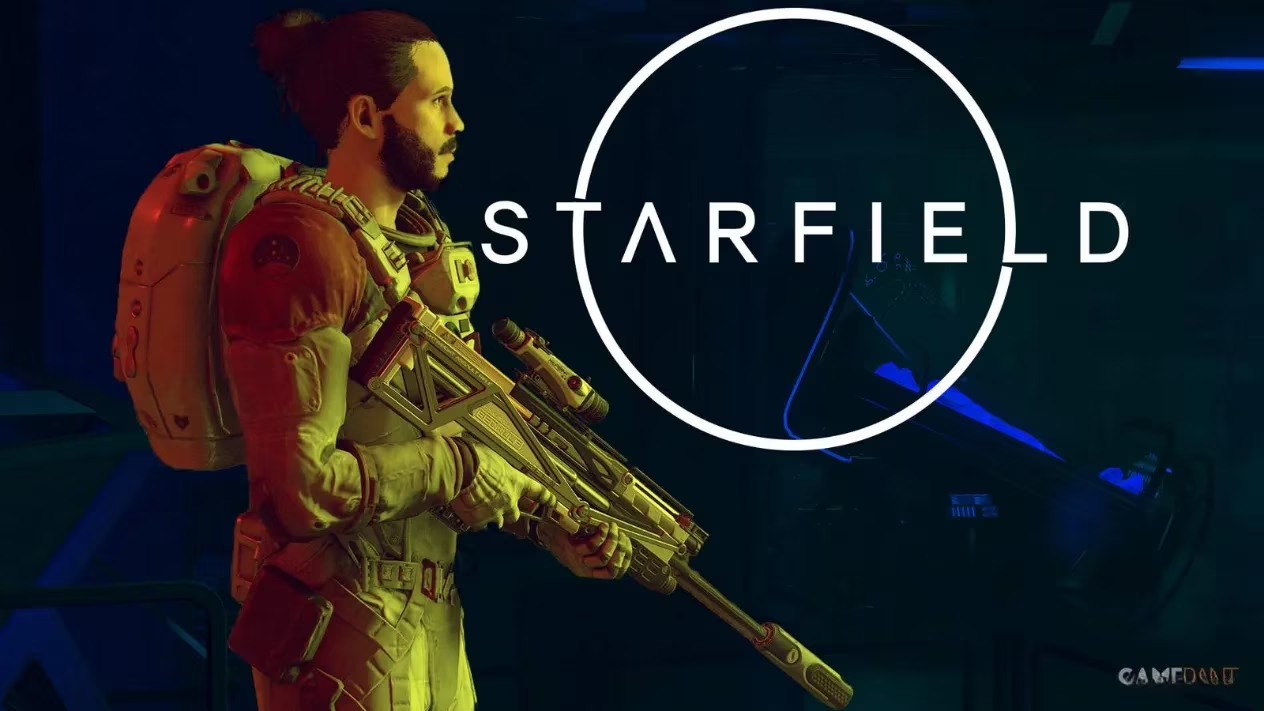
Nesmith’s optimism isn’t born from blind faith but from a developer’s understanding of iterative evolution—a process he likens to an astronomer crafting ever-larger lenses to peer deeper into uncharted space. He recalls how Morrowind, itself a groundbreaking but quirky third entry in The Elder Scrolls, provided a “tremendous advantage” when building Oblivion. That foundation, in turn, became a launching pad for Skyrim, which polished the open-world formula to near-legendary status. “It takes, sadly, sometimes a second or third version of the game in order to really enrich everything,” Nesmith explained, his words echoing the patient philosophy of a vintner who knows a young Bordeaux needs decades to soften its tannins. The former developer sees Starfield not as a finished mural but as the first broad strokes on a vast canvas; the sequel, he suggests, will layer in the intricate details that convert a concept into a cosmos.
During his tenure at Bethesda, Nesmith worked as a system designer across multiple franchises, contributing to The Elder Scrolls III: Morrowind, Oblivion, Skyrim, Fallout 3, Fallout 4, and even the controversial Fallout 76. His departure in 2021 to pursue fantasy novel writing didn’t sever his connection to Starfield—he served as a system designer on the project, helping shape core mechanics that govern everything from spaceship flight to alien encounters. That intimate knowledge of the game’s DNA makes his assessments particularly weighty. He acknowledges that players voiced legitimate frustrations after the 2023 launch: loading screens fractured exploration, procedural generation sometimes felt barren, and the main storyline lacked the gripping urgency of Bethesda’s earlier epics. But in Nesmith’s eyes, these flaws are the raw material from which a superior sequel can be forged—much as a blacksmith recognizes that the first hammer blow only roughly outlines a blade, and it is the subsequent heating and quenching that produce a razor’s edge.
Starfield’s development cycle already stretched past seven years, longer than any previous Bethesda title. That marathon of creation, fraught with pandemic disruptions and engine overhauls, left the team with a wealth of systems that can now be refined rather than rebuilt. Nesmith points out that if Bethesda had been forced to start from scratch with each 3D fantasy RPG, Oblivion and Skyrim would have each consumed “two or three years” longer. The same logic applies to Starfield 2: the procedural galaxy engine, the ship customization framework, the outpost-building tools—these are now existing scaffolding that a sequel can inhabit and expand. Instead of devoting years to laying foundations, developers could dedicate their energy to populating planets with handcrafted stories, deepening faction dynamics, and weaving the vast emptiness into something far more vibrant. The metaphor of a fledgling composer comes to mind; a first symphony may be competent but tentative, its themes not fully explored. Only with a second symphony does the composer’s true voice soar, the motifs now interwoven with confidence and emotional depth.
Despite the passionate anticipation, the timeline for a Starfield sequel stretches into the horizon like a star system that looks close but is hundreds of light-years away. Bethesda’s roadmap, as repeatedly confirmed by Executive Producer Todd Howard, prioritizes The Elder Scrolls VI—currently in early development and expected around 2029. Immediately thereafter, the studio will shift focus to Fallout 5. With AAA development cycles showing no sign of shortening, industry analysts project Fallout 5 to emerge by roughly 2034. That means Starfield 2 couldn’t even enter full production until the mid-2030s, making a late 2030s release the most optimistic scenario. For fans who first boarded their ships in 2023, the wait could span over a decade—a span of time during which a child born at launch would be approaching high school graduation by the time the sequel appears.
Yet the prolonged gap may ultimately serve the franchise well. Much as The Elder Scrolls needed Morrowind’s experimentation to unlock Skyrim’s mainstream triumph, Starfield might require this temporal distance to mature into the game Nesmith envisions. When it finally does arrive, Starfield 2 will land in a gaming landscape hungry for the kind of sprawling, singular sci-fi experience that Bethesda alone can deliver. The tools, the feedback, the lessons—they will all be there, waiting to be sharpened by a team that, by then, will have seen multiple game generations pass. If Bruce Nesmith’s prophecy holds true, the second voyage through the Settled Systems won’t just refine the original; it will launch the franchise into a legend as enduring as the Elder Scrolls themselves.