From Oblivion to Starfield: Bethesda's Evolution and the Case for Quality Over Quantity in Open-World Design
As the gaming industry barrels toward 2026, the legacy and future of Bethesda Game Studios (BGS) remain a hot topic in player circles and critical discourse. The recent release of The Elder Scrolls 4: Oblivion Remastered has thrown this conversation into sharp relief, acting as a time capsule that highlights both how far the studio has come and the core design tenets it has stubbornly clung to. For a studio that once defined the gold standard for immersive western RPGs, its journey has been, well, a real rollercoaster—a mix of groundbreaking ambition and contentious execution. The tension between BGS's evolutionary leaps, as seen in the astronomically scaled Starfield, and its nostalgic roots in titles like Oblivion, creates a fascinating case study in modern game development. It's this very tension that has made their latest cosmic outing so polarizing, sparking debates that echo from online forums to developer roundtables about what truly makes an open-world game sing.
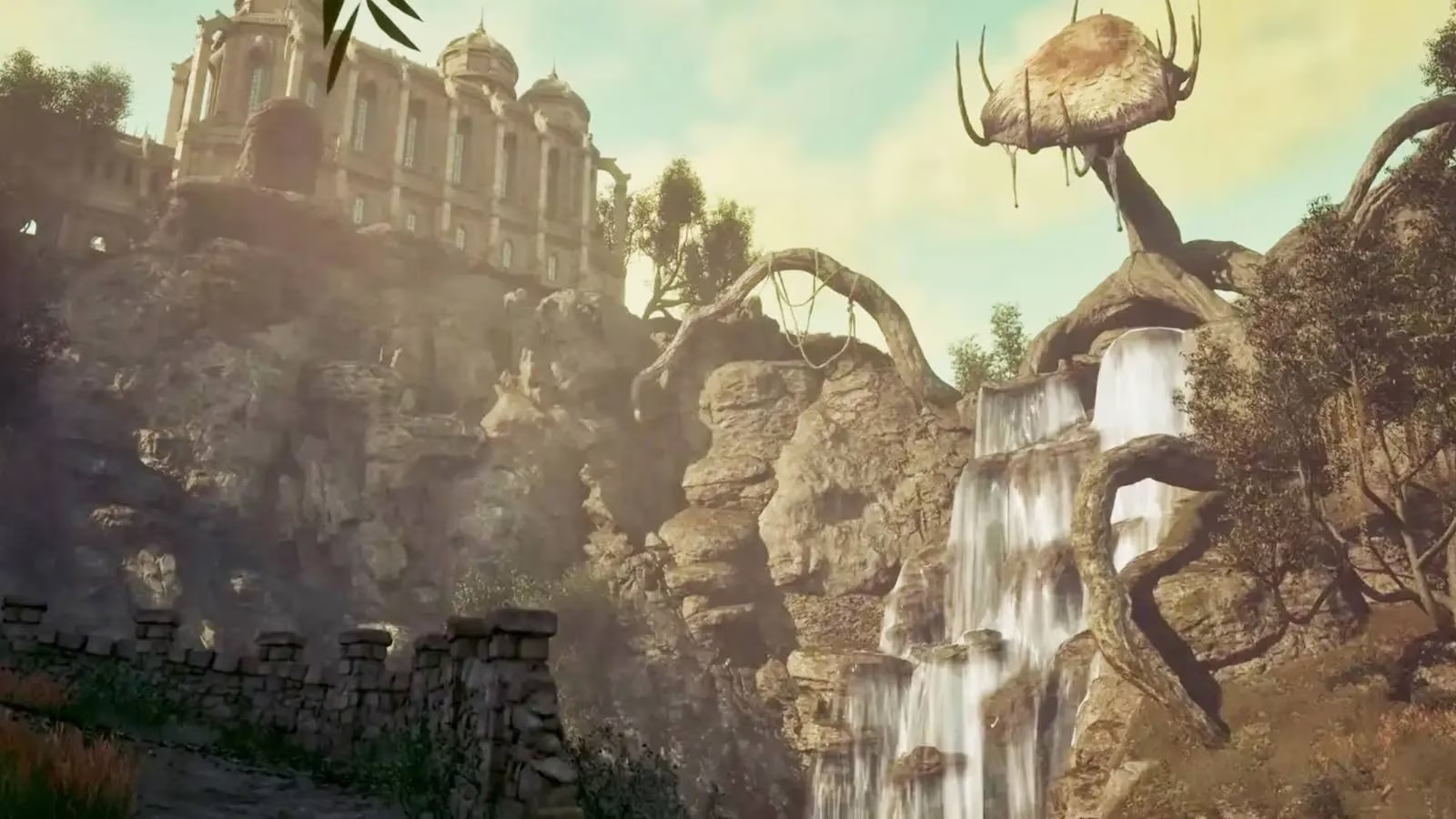
The Dense, Curated World of Cyrodiil: A Masterclass in Pacing
Let's cut to the chase: Oblivion Remastered is no small game. The province of Cyrodiil is massive. Yet, it stands in stark contrast to the everything-and-the-kitchen-sink philosophy of its spiritual successor, Starfield. Cyrodiil's genius lies not in sheer square mileage but in its masterful density and curation. Players are rarely, if ever, left adrift. The world is designed with a rhythmic precision—you're never more than thirty seconds of travel from stumbling upon something compelling. This could be:
-
A hidden bandit camp tucked into the woods 🏕️
-
The ominous entrance to a dungeon begging to be plundered 🕳️
-
A seemingly abandoned ruin hiding a cache of unique loot 💎
This approach creates a gameplay loop that feels consistently rewarding. Exploration is never a chore because the payoff is frequent and meaningful. The world feels alive and handcrafted, encouraging players to peek around every corner. It's a finely-tuned ecosystem where space is used intentionally, proving that a world doesn't need to be astronomically large to feel expansive and full of secrets. In many ways, Oblivion nailed the sweet spot between freedom and guidance, a lesson that feels especially poignant today.
Starfield's Cosmic Scale: Ambition vs. Execution
Fast forward to Starfield, and Bethesda's ambition has literally shot for the stars. With over 1,000 planets, the game's scale is, without a doubt, a technical marvel. It delivers on a promise of near-infinite possibility, allowing players to become true cosmic pioneers. On paper, it's the ultimate power fantasy. But here's the rub: for a significant portion of players, that vastness came with a cost. The quantity-over-quality critique isn't new, but Starfield embodied it for many.
The game often operates on a carrot-on-a-stick principle. The next planet, the next outpost, the next solar system always glimmers just over the horizon. Yet, the journey to these points of interest can be punctuated by long stretches of procedural emptiness. While the sheer plenitude is impressive, it can lead to a sense of dilution. When unique, handcrafted content is spread across a galaxy, the moments of genuine discovery can feel farther apart. This design choice hearkens back to an older era of open-world games where map size was the primary bragging right, an approach the industry has largely moved past in favor of more curated, dense experiences.
The Open-World Spectrum: From No Man's Sky to the Streets of Kamurocho
To understand Bethesda's position, it helps to look at the broader open-world landscape. Modern games generally fall somewhere on a spectrum between two extremes:
| Design Philosophy | Example Games | Core Strength | Potential Pitfall |
|---|---|---|---|
| Vast & Systemic | No Man's Sky, Elite Dangerous | Unparalleled freedom, endless procedural generation | Can feel repetitive or lacking curated narrative depth |
| Dense & Handcrafted | Yakuza/Like a Dragon series | Rich narrative, detailed environments, high activity density | World can feel small or thematically narrow |
Most successful titles find a balance. Oblivion sits comfortably in the middle—large enough to feel epic, but dense enough to feel meticulously crafted. Starfield, in its quest for ultimate scale, leaned heavily toward the former column. The result is a game that is a great accomplishment in scope but one that also highlights the risks of prioritizing breadth over depth. As the saying goes, familiarity breeds contempt; spending hours traversing largely empty biomes can breed player resentment, no matter how stunning the stellar vistas are.
Lessons for the Future: Going Smaller to Think Bigger
So, where does Bethesda go from here? The studio has unequivocally proven it can build a universe. The next logical step isn't to make an even bigger one. The real virtue, and the potential path back to the iconic, genre-defining status of titles like Oblivion, Skyrim, and Fallout 3, might lie in going smaller. This means a conscious shift in focus:
-
Density Over Abundance: Concentrate meaningful content. Make every location, every quest, every character encounter feel significant and hand-touched.
-
Quality Over Quantity: It's better to have 50 unforgettable planets than 950 forgettable ones. Cull the procedural chaff to highlight the bespoke wheat.
-
Intentional Design Over Sheer Scale: Use space as a narrative and gameplay tool, not just a metric for marketing bullet points.
Oblivion Remastered serves as a timely reminder of Bethesda's foundational strengths. It's a world that feels lived-in and purposeful. For future projects, whether The Elder Scrolls VI or a new IP, the studio has a clear blueprint in its own back catalog. The goal shouldn't be to simply build a bigger sandbox, but to fill it with better, more engaging toys. The gaming world in 2026 is hungry for worlds that are not just vast, but truly deep—worlds that respect the player's time by ensuring every journey, no matter how small, has the potential for a great story. Bethesda has the talent and the legacy; it's just a matter of remembering that sometimes, less really is more.