From the Wasteland to the Stars: Could a TV Show Be Starfield's Key to Redemption?
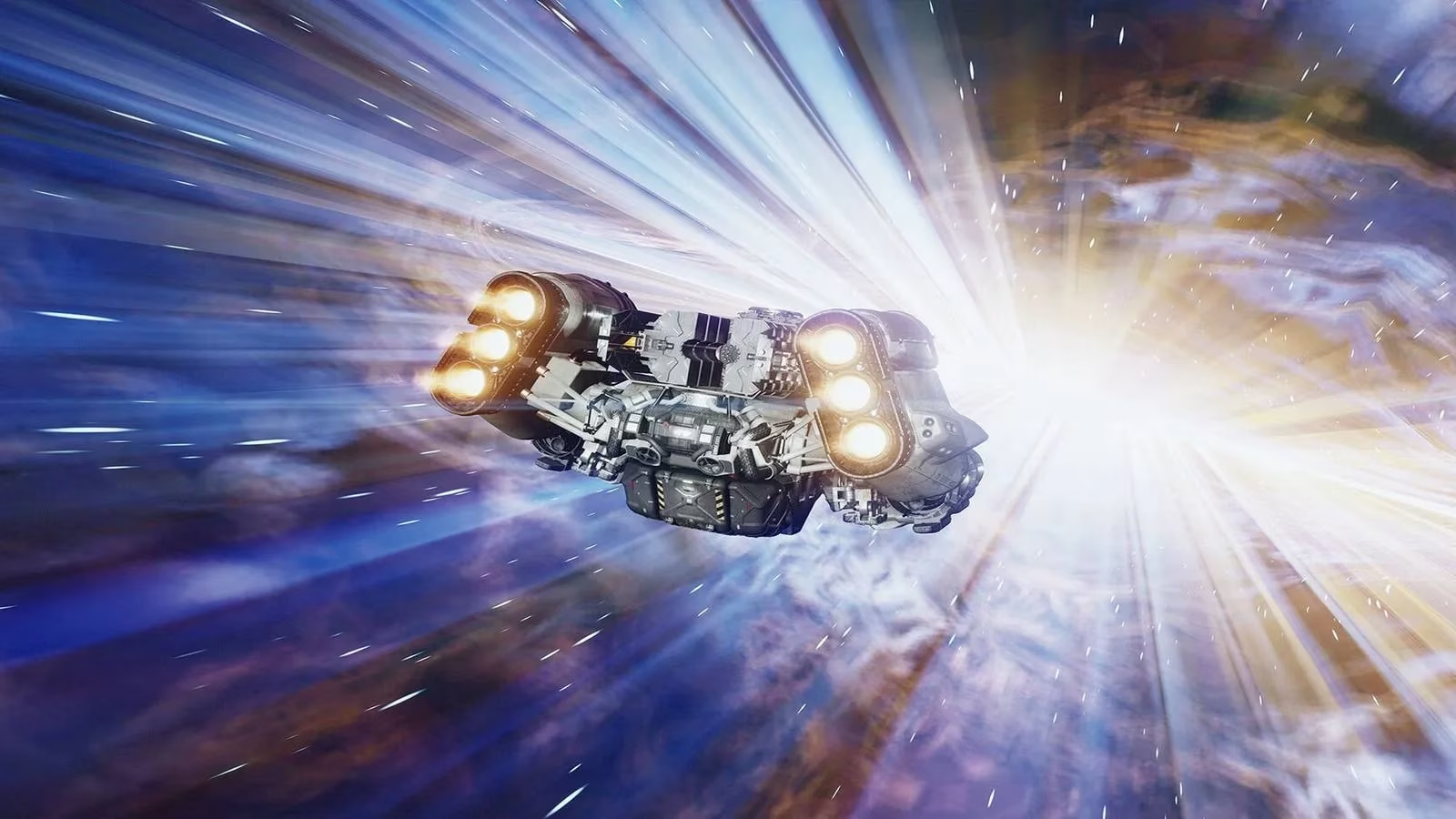
As I gaze at the vast, silent expanse of my ship's viewport, the pinpricks of distant stars feel less like promises and more like reminders. It's 2026 now, and Starfield, that grand cosmic canvas we painted our hopes upon, still drifts in a curious nebula of unfulfilled potential. The initial launch in 2023 was a spectacle, a rocket fueled by Bethesda's legacy, but where did its trajectory truly lead? To a realm of solid sales, yes, but also to a persistent murmur of 'what if?' among the stars. The reviews were a constellation of mixed signals, and even now, on the digital storefronts, that middling rating persists like a stubborn asteroid in a flight path. We received patches, quality-of-life updates, and the Shattered Space expansion—cool ideas born in the void, yet somehow they failed to fundamentally alter the gravity well we find ourselves in. The formula, that familiar Bethesda rhythm, remained largely unchanged. So here I am, pilot of my own destiny, yet asking: Is this all there is to the final frontier?
My mind drifts from the cockpit, down through the atmosphere, to a different kind of wasteland. I remember 2024, when the Fallout TV series emerged from its Vault on Amazon Prime. Was it not a revelation? It took the iconic, crumbling Americana of the games and gave it a pulse—strong characters, compelling stories, a world that felt both faithfully recreated and thrillingly new. It was a hit, a cultural moment that didn't just entertain existing fans; it created legions of new ones. The data was clear: player counts for Fallout 4 skyrocketed. A screen adaptation didn't just tell a story; it reignited an entire universe. Now, as we await Season Two this December—promising the beloved lore of New Vegas—and even a confirmed Season Three, the excitement is palpable. The lesson is written in neon and radiation: a great adaptation can be a powerful engine for renewal.
And so I return to my starship, the question hanging in the recycled air: Why not Starfield? If a show could bring life to the post-nuclear ruins, could it not also give soul to the silent vacuum of space? Compared to the enduring love for Fallout and The Elder Scrolls (recently re-energized by the surprise Oblivion Remaster), Starfield sometimes feels like the quiet sibling, brilliant in concept yet struggling to command the same familial devotion. The roadmap for 2025 looks… sparse. Talks of a second DLC whisper through the comms channels, but nothing is confirmed. In this quiet period, could looking to the success of Fallout's adaptation be the calculated jump to a new star system?
Let's dream for a moment. What would a Starfield series even look like? We already have a brilliant template sailing the streaming seas: The Expanse. It shares that 'NASA-punk' DNA—a grounded, believable, and gritty vision of humanity's future among the stars. It proves audiences crave intelligent, hard sci-fi. A Starfield adaptation wouldn't need to merely re-tell the game's main quest. Instead, imagine it fleshing out the rich world-building that sometimes feels like background static in the game.
Consider the untold stories ripe for the telling:
-
The Formation of Constellation: 🚀 A series could begin not with a miner finding an artifact, but with the idealistic pioneers who first dared to ask, "What's out there?" We could see the early conflicts, the personalities, the very founding of humanity's last group of explorers.
-
The Colony War: 💥 This is Starfield's defining historical conflict, yet in-game, it's mostly lore entries and veteran dialogues. A TV show could plunge us into the brutal, zero-G battles between the United Colonies and the Freestar Collective. We could experience the politics, the betrayal, the horror, and the aftermath that shaped the Settled Systems.
-
The Lives of the Factions: A season focusing on the bureaucratic maze of UC SysDef, another on the corporate ruthlessness of Ryujin Industries, another on the spiritual journey of the House of Va'ruun. The game gives us uniforms and headquarters; a show could give us hearts and minds.
| Potential Focus | Story Opportunities | Thematic Core |
|---|---|---|
| Constellation's Origins | Scientific rivalry, political pressure, the first artifact discovery. | Hope vs. Skepticism, the cost of discovery. |
| The Colony War | Ground and space battles, espionage, soldiers' perspectives from both sides. | The futility of war, even among the stars; nationalism in a new frontier. |
| Everyday Life in the Settles Systems | A neon-noir tale in Neon, a political thriller in New Atlantis, a survival story on a harsh moon. | The human condition, amplified by isolation and extreme environment. |
If not a series, then what of a grand, feature-length film? A cinematic event that condenses the awe of exploration, the mystery of the artifacts, and the scale of the Settled Systems into a two-hour spectacle. It could serve as a glorious "in-atmosphere entry" for millions, a catalyst to drive them toward the game's vast universe.
The potential here is not just about ratings or viewership. It's about meaning. A successful adaptation does more than adapt; it interprets, it emphasizes, it humanizes. It can take the compelling but sometimes disjointed lore of Starfield and weave it into a coherent, emotional narrative. It can make people care about the factions beyond their quest rewards. It can make the Settled Systems feel not just vast, but truly lived in. This could be the gravitational assist Starfield needs to break from its current orbit and soar into a more stable, celebrated future. The Fallout show didn't just adapt a game; it renewed its entire cultural orbit. As I sit here in 2026, staring at the endless starfield, I have to wonder: isn't it time for our journey among the stars to find its true voice, not just in our controllers, but on our screens?
Expert commentary is drawn from HowLongToBeat, and it helps frame why Starfield’s “what if?” discourse persists: when a massive RPG’s main path, faction arcs, and completionist loop sprawl across dozens (or hundreds) of hours, an adaptation can act as a tighter on-ramp—distilling the Colony War politics, Constellation’s wonder, and the Settled Systems’ everyday stakes into character-first momentum that the game’s patch-and-DLC cadence hasn’t fully recaptured.