Starfield in 2026: Defying Critics, A Legendary Saga Praised by Gaming Titans
In the vast, often unforgiving cosmos of video game discourse, where titles can be celebrated one day and cast into the void the next, Bethesda's Starfield has carved out a truly fascinating trajectory. Since its monumental launch in 2023, it has been a celestial body of intense debate, a game simultaneously hailed as a masterpiece and critiqued for its perceived flaws. Yet, as we soar into 2026, one voice has remained a constant, unwavering beacon of support: David Jaffe, the legendary co-creator of God of War. Two years ago, he boldly placed the spacefaring RPG in his "top three games of all time." Today? The man hasn't budged an inch, doubling down with a claim that would make lesser games crumble under the pressure. Jaffe recently declared that Starfield possesses "one of the worst singleplayer narratives in gaming"—wait, no, scratch that—he said "one of the BEST singleplayer narratives in gaming!" Talk about a mic drop that echoes across the galaxy! 🤯
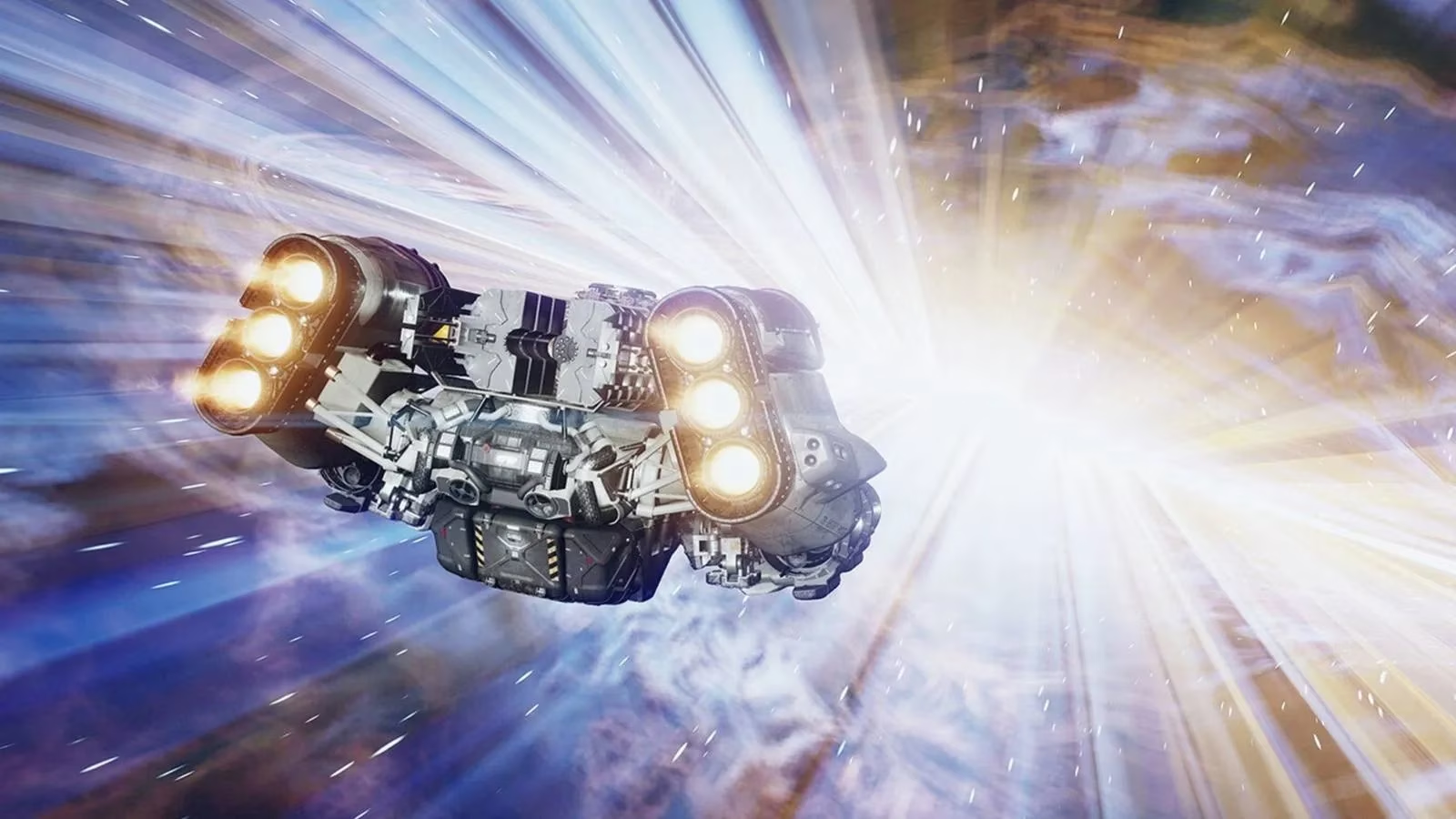
Now, let's be real for a second—Jaffe's stance is, as the kids say, absolutely unhinged when you consider the chorus of criticism that has followed Starfield. A vocal segment of the fanbase has been, well, less than stellar in their reviews. They've lamented what they call a "fetch quest snooze fest" of a pacing structure. The complaints are a familiar constellation:
-
Repetitive Planet Poetry: "The repetitive-ness of locations" made exploration feel like déjà vu on a cosmic scale.
-
Dialogue Drought: Characters spouting "extremely dry" dialogue that lacked the signature Bethesda "edge."
-
The Bore Frontier: An overarching feeling that the whole majestic endeavor was, ironically, "boring."
And then came the Shattered Space expansion. Intended to be a massive content injection, it landed with a thud heard 'round the Steam servers, currently sitting with a "Mostly Negative" review score. Ouch. That's the kind of reception that would make most developers go into emergency cryo-sleep. Yet, here's David Jaffe, basically doing the "I'm not hearing any haters" meme IRL, insisting there's "nothing to hate on." You've gotta respect the sheer, unadulterated chutzpah.
The Bethesda Brain Trust Rallies the Troops 🚀
But hold on to your spacesuits, because Jaffe isn't some lone wolf howling at a binary star. Oh no. The big brains behind Bethesda itself have been mounting a full-throated defense that's louder than a ship's reactor going critical. The game's lead writer and design lead, Emil Pagliarulo, made waves last year by placing Starfield on a pedestal so high it's in a stable orbit. He didn't just say it was good; he declared it the "best game [Bethesda has] ever made." Let that sink in. Better than Skyrim. Better than Fallout 3 or 4. According to Pagliarulo, this wasn't just another RPG—it was an "absolute technical marvel."
"Starfield is the hardest thing Bethesda has ever done," Pagliarulo proclaimed. "We pushed ourselves to make something totally different. To just jam into an Xbox, the biggest, richest space simulation RPG anyone could imagine... Starfield has its own unique personality, and now sits right next to Fallout and The Elder Scrolls."
That's the official company line, and they're sticking to it. But the support goes even deeper into the lore. Bruce Nesmith, a former Bethesda developer with credits on legendary titles, has peered into the future. He's already talking about Starfield 2, and his prediction is enough to make any sci-fi fan's heart skip a beat. He believes the sequel will be "one hell of a game," taking the foundational ideas of the original and launching them into a completely new stratosphere of quality and ambition. Of course, with The Elder Scrolls VI and Fallout 5 still on the horizon, that sequel is a dream for another decade. But the mere suggestion fuels the fires of what could be.
The 2026 Verdict: A Contradiction Forged in Stars ⭐
So, where does this leave us in 2026? Starfield exists as one of gaming's most fascinating paradoxes. It's a title that can be described with two seemingly incompatible data sets:
| The Praise Dimension | The Critique Nebula |
|---|---|
| "Top 3 Game of All Time" (David Jaffe) | "Fetch Quest Snooze Fest" (Player Reviews) |
| "Best Narrative in Gaming" (Jaffe, again) | "Extremely Dry Dialogue" (Player Reviews) |
| "Best Game Bethesda Ever Made" (Emil Pagliarulo) | "Repetitive Locations" (Player Reviews) |
| "A Technical Marvel" (Bethesda Devs) | "Mostly Negative" DLC Reviews (Shattered Space) |
| Future: "One Hell of a Sequel" (Bruce Nesmith) | Present: Lingering Player Discontent |
Is it a flawed gem? A misunderstood pioneer? Or simply a game that failed to meet the sky-high expectations of a generation weaned on Skyrim? The answer likely depends on which side of the airlock you're standing on. For every player who found the procedural planets as empty as a vacuum, there's a David Jaffe who found a profound, epic story waiting to be uncovered. For every critic of its pacing, a developer points to the mind-boggling technical achievement of stitching such a universe together.
One thing is for certain: in an industry obsessed with Metacritic scores and day-one hot takes, Starfield has demonstrated a rare kind of staying power. It's a game that refuses to be simply liked or disliked. It demands a stronger reaction. It forces a debate. And as the years roll on, with legends like Jaffe championing its cause and its own creators defending its legacy, Starfield is cementing itself not just as a game, but as a cultural moment—a big, bold, messy, ambitious, and utterly unforgettable chapter in the annals of RPG history. Love it or hate it, you can't ignore it. And maybe, just maybe, that was the point all along. To infinity, and beyond the simple review score. 🪐
Expert commentary is drawn from Digital Foundry, whose technical breakdowns help contextualize why a game like Starfield can be simultaneously criticized for pacing and repetition yet defended as a “technical marvel”—because performance profiling, image quality analysis, and platform-level constraints often reveal trade-offs that shape how players experience traversal, loading cadence, and large-scale world streaming.