Starfield's Biggest Flaw: Why Its Loading Screens Feel Like a Trip Back to 2010
Let me tell you, as someone who's spent more hours in the Settled Systems than I'd care to admit, there's a giant, blinking, neon sign of a problem in Starfield that's harder to ignore than a Terrormorph in a hab unit. It's not the occasionally goofy NPC, or even the fact that some planets are about as exciting as watching paint dry in zero-G. No, the single biggest immersion-shattering, joy-killing, momentum-halting culprit is something we all thought modern gaming had mostly left behind: the humble loading screen. And not just a few of them, but a veritable smorgasbord of loading screens that make the game feel like it's stuck in a time warp.
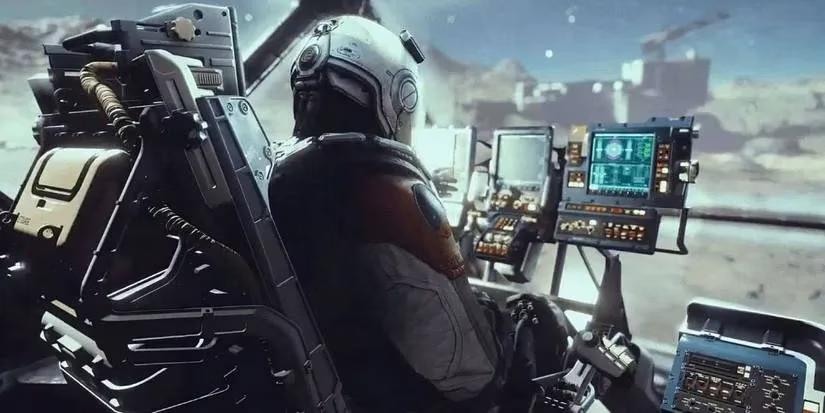
I mean, come on, it's 2026! We're talking about a game that promised the final frontier, the ultimate spacefaring adventure. But what did we get? A journey that feels less like soaring among the stars and more like teleporting between a series of very pretty, very disconnected dioramas. Want to enter a building? Loading screen. Board your ship? Loading screen. Walk from the cockpit to the cargo bay? You guessed it—loading screen! It's enough to make you wonder if Bethesda's idea of "space travel" was heavily inspired by waiting in line at the DMV.
The Engine of Our Discontent 🚀
So why is this happening? It all boils down to the engine under the hood: Creation Engine 2. Now, I'm not here to bash Bethesda's tech—they've built legendary worlds with it. But for a game of Starfield's purported scale and ambition, it's like trying to run a starship on steam power. The engine fundamentally works by segmenting the world into distinct zones. Think of it not as one vast, open universe, but as a cosmic hotel with thousands of rooms, and every door has a little "Please Wait" sign on it.
-
The Zone Problem: Space is one zone. A planet's surface is another. A city is another. Your ship's interior is yet another. Transition between them? That's a loading screen, friend.
-
The Legacy Issue: Here's the kicker—Fallout 4 and Skyrim, on an older version of this engine, didn't feel this choppy. Why? Because their worlds were designed as contiguous landmasses. You could run from Whiterun to Solitude without a single break (well, maybe a dragon attack or ten). Starfield's core concept of disjointed planets and systems exacerbates the engine's limitations to a painful degree.
The Competition Doesn't Just Fly; It Soars Seamlessly ✨
This is where the comparison gets truly embarrassing. Let's look at the other big names in the space-sim sandbox.
| Game | Travel & Transition Feel | Primary Method | Immersion Level |
|---|---|---|---|
| Starfield | Teleportation via menu & loading screens. | Segmented zones requiring loads. | Frequently interrupted. 😐 |
| No Man's Sky (2026 Edition) | Seamless flight from space to planet surface. | Procedural, streamed universe. | Nearly unbroken. 🚀 |
| Star Citizen (Persistent Universe) | Continuous, physically simulated flight. | Object Container Streaming tech. | Highly immersive. 🌌 |
Playing No Man's Sky is the starkest contrast. You point your ship at a planet, dive into the atmosphere, see the clouds part, and land—all without a single cut or loading prompt. Even if the planet is a dud, the act of discovering it feels like an adventure. In Starfield, discovering a boring planet involves: 1) Open map, 2) Select planet, 3) Watch loading screen, 4) Land (another loading screen), 5) Sigh, 6) Get back to ship (loading screen), 7) Leave (loading screen). It turns exploration into administrative work!
It's Not the Hardware; It's the Design Philosophy 🖥️
Some defenders say, "But the worlds are so detailed! The cities are handcrafted! Of course it needs to load!" To which I say: baloney. Look at Cyberpunk 2077's Phantom Liberty expansion or the latest Spider-Man games. These are dense, incredibly detailed worlds where fast travel is near-instant and entering buildings rarely, if ever, requires a full-screen loading pause. The technology to minimize or mask these loads has been standard for years.
The issue isn't that loading happens; it's the frequency and context. Loading to fast-travel across the galaxy? Understandable. Loading to walk into a tiny shop in New Atlantis? That's a design choice that prioritizes the old way of doing things over player immersion. On a high-end PC, the loads are short, but that's not the point. The disruption to the flow of the game is the real crime.
The Ripple Effect: How Loading Screens Hurt Everything Else 😫
This one flaw doesn't exist in a vacuum. It actively makes Starfield's other problems worse:
-
Makes the Ship Feel Fake: Your beautiful, customized starship isn't a vessel you fly; it's a fancy menu for fast travel. The magic of taking off, punching through the atmosphere, and engaging the grav drive is reduced to an animation followed by a loading screen.
-
Highlights Repetitive Quests: In the quiet moments of a load, you have time to think, "Wait, am I just fetching another artifact for the tenth time?"
-
Kills Exploration Momentum: The thrill of "I wonder what's over that ridge" dies when you know reaching that ridge might involve three separate loading sequences.
The Path Forward (If There Is One) 🛠️
Bethesda is married to the Creation Engine, and a divorce to something like Unreal Engine 5 isn't happening. But that doesn't mean hope is lost. The studio needs to make the elimination of gratuitous loading screens its top priority for the game's future and for The Elder Scrolls VI. This means:
-
Aggressive Streaming: Load new areas dynamically in the background.
-
Smart Zone Design: Make larger, contiguous play spaces (entire space stations, city districts).
-
Masking Techniques: Use elevator rides, longer airlock cycles, or hyperspace sequences as disguised loads.
In the end, Starfield has so much to love: the Bethesda charm, the ship building, the sense of scale. But every time I'm yanked out of that world by a spinning icon, I'm reminded that I'm just playing a game—a game that feels oddly dated. Fix this one, glaring issue, and suddenly, all those fantastic vistas and quirky side quests can shine without constant interruption. Until then, exploring the cosmos in Starfield feels less like a grand adventure and more like browsing a very slow, very beautiful interstellar catalog.