Starfield's Galactic Silence: Can Bethesda Replicate Fallout 76's Gone Fission Miracle?
As the digital dust settles from the Xbox Games Showcase of 2026, a profound, echoing silence hangs over the constellation of Starfield fans. For over a year, since the launch of the 'Shattered Space' DLC, Bethesda's grand cosmic opera has drifted in a communications black hole, its future plans more mysterious than a dark matter nebula. While its sibling, the once-maligned Fallout 76, basks in the glow of its transformative 'Gone Fission' update—a renaissance complete with the serene pastime of fishing—Starfield remains adrift, its engines cold and its potential untapped, leaving its community to scan the static of space for any signal of hope.
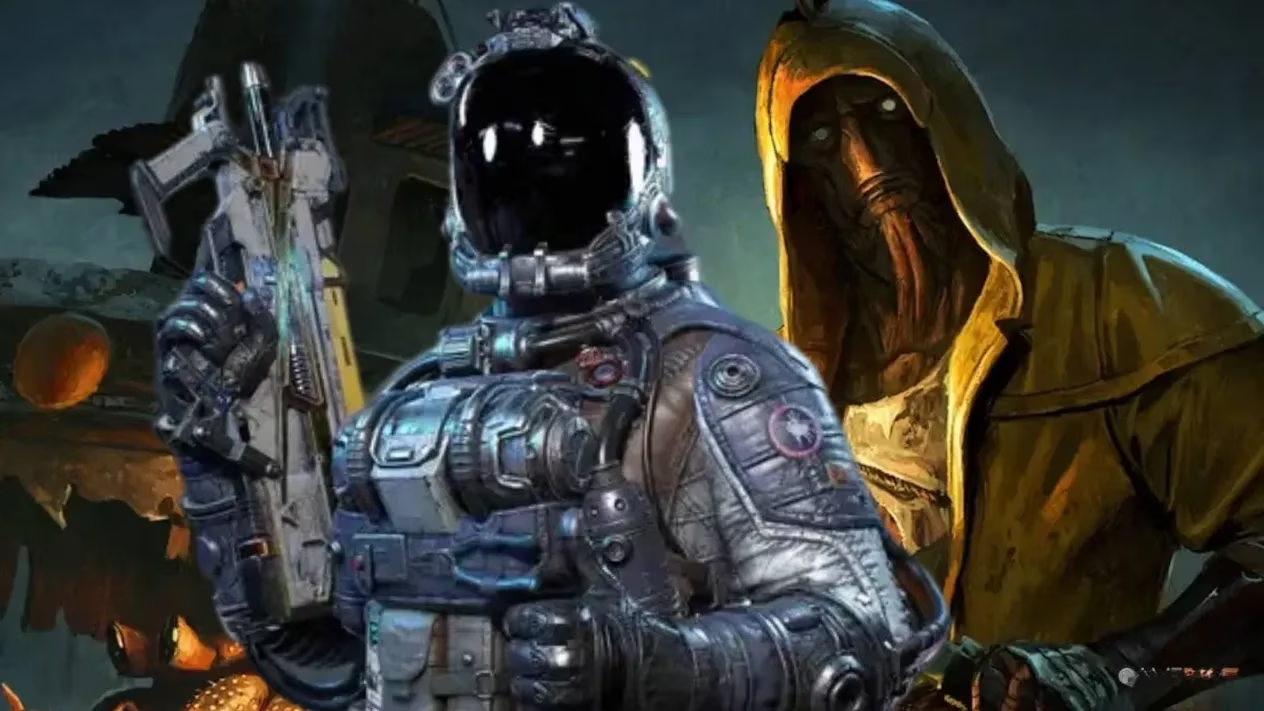
Let's be clear: Starfield is not without its stellar qualities. Its ship customization is a mechanical ballet of parts and power, allowing players to construct vessels that are less like spaceships and more like personalized cathedrals of chrome and ambition. Its base-building, scattered across a thousand worlds, offers the promise of empire-building on an interstellar scale. Yet, for all its technical grandeur, the universe itself has been criticized as a vast, beautiful, but ultimately flavorless buffet—a cosmic salad bar where every planet, no matter its biome, seems to be dressed with the same metaphysical ranch dressing. The game has struggled to ascend to the narrative Olympus once occupied by titles like Skyrim or Fallout 3, its worlds feeling as connected as marbles scattered on a gymnasium floor.
This is where the ghost of Appalachia, resurrected and thriving, offers a beacon. Fallout 76's journey from a glitch-riddled punchline to a beloved, living world is a masterclass in post-launch redemption. The 'Gone Fission' update wasn't just about adding fishing; it was about injecting soul. It proved that small, cozy mechanics could act as a gravitational core, pulling players deeper into the world's atmosphere. For Starfield, a game whose modding community has dwindled like a dying star and whose endgame often feels as empty as the void between galaxies, this lesson is paramount.
What Starfield Desperately Needs: A Blueprint from the Wasteland
Consider the current state of affairs:
| Aspect | Fallout 76 (Post-Gone Fission) | Starfield (Current, 2026) | The Lesson |
|---|---|---|---|
| World Liveliness | 🎣 Teeming with side activities, community events, and ambient life. | 🪐 Technically vast but often sterile and quiet. | A world needs a heartbeat, not just a map. |
| Player Retention | 📈 Strong, sustained engagement through seasonal content and cozy loops. | 📉 Drops sharply after main story; modding scene cooling. | Give players a reason to linger, not just a place to be. |
| Post-Launch Updates | 🚀 Consistent, meaningful additions that expand the feel of the game. | ⚙️ One major addition (REV-8 vehicle), then... silence. | Substantial updates must be both flashy and foundational. |
Bethesda's introduction of the REV-8 land vehicle was a promising tremor, a sign that the developers understood the need for better traversal across those expansive, empty plains. But a vehicle is just a faster way to cross a desert; it doesn't make the desert any more interesting to explore. What Starfield needs now is not necessarily a second DLC the size of 'Shattered Space'—though rumors of one and a PS5 port continue to swirl—but a series of 'Gone Fission'-style injections.
Imagine this:
-
Astro-Angling: Deploy a magnetic line to fish for bizarre, bio-luminescent space eels in the methane seas of Neon.
-
Xeno-Botany: Cultivate and cross-breed alien flora at your outpost, creating new resources or even defensive organisms.
-
Derelict Drone Salvage: A quiet, systematic mini-game of carefully extracting valuable parts from ancient, floating shipwrecks.
These activities would be more than checklist items. They would be the interstitial glue for the universe, the quiet moments that make the loud ones resonate. They would transform planets from mere resource nodes into places with texture, rhythm, and reason to visit beyond a quest marker. A player might land on a planet not to raid a pirate base, but simply to see what strange fish swim in its crimson lakes, making the galaxy feel less like a themed park of combat encounters and more like a home—or at least a fascinating backyard.
The silence from Bethesda is deafening. The missed opportunity at the 2026 Xbox Showcase was a gut-punch for fans hoping for a roadmap. But perhaps this silence is not a sign of abandonment, but of recalibration. To replicate Fallout 76's comeback, Bethesda must look at Starfield not as a monolithic artifact to be expanded with grand, chiseled DLC, but as an ecosystem to be seeded with life, one small, thoughtful mechanic at a time. A 'Gone Fission' for Starfield wouldn't just add fishing; it would signal a fundamental shift in philosophy—from building a universe wide enough to get lost in, to building one deep enough to want to stay.
The potential is astronomical. Starfield's universe is a canvas as vast as human imagination, but it remains frustratingly two-dimensional. Injecting it with the kind of thoughtful, world-building minutiae that saved Fallout 76 could be the key. It would be a transformation as dramatic as a nebula collapsing into a star—a shift from cold potential to radiant, sustained energy. The ball is in Bethesda's court. Will they let it float in zero gravity, or finally give it a push?