Starfield's Rocky Road: Can Bethesda's Space Saga Have a No Man's Sky-Style Comeback?
When Bethesda's ambitious space epic, Starfield, finally launched, it carried the hefty expectation of being "Skyrim in space." However, its post-launch journey has been more turbulent than a solar flare, leaving many wondering if it can ever truly achieve its cosmic potential. The game finds itself in a peculiar mirror universe to another spacefaring title, No Man's Sky. While Hello Games' creation started with vast, beautiful emptiness and filled it with life through years of dedicated updates, Starfield arrived with plenty of content but is often bogged down by gameplay that feels curiously antiquated. The dream of seamless space exploration is frequently interrupted by the reality of clunky menus and a constant parade of loading screens, making the experience feel more like interstellar bureaucracy than boundless adventure.
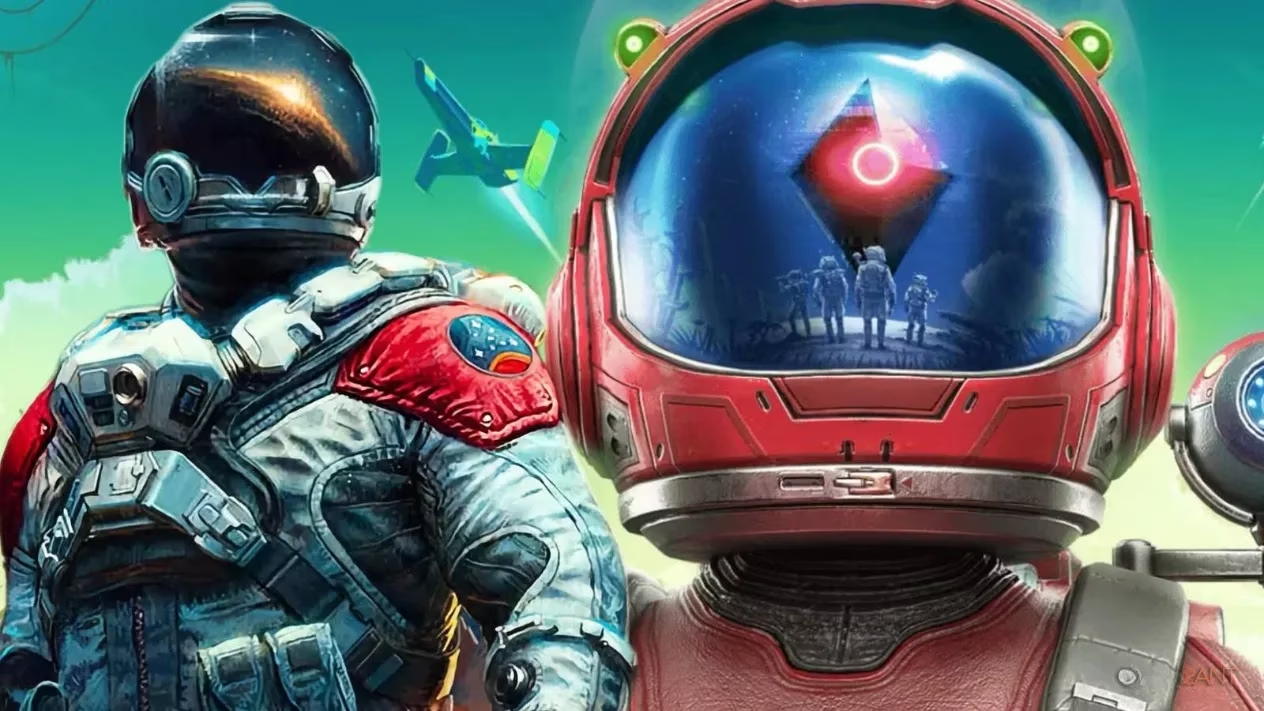
The Ghost of Gameplay Past 👻
One of the most persistent criticisms leveled at Starfield is that its core gameplay loop can feel like a relic from a bygone era. For a game set in humanity's future, its mechanics are surprisingly old-fashioned. Players have voiced their frustrations with a litany of issues:
-
Navigation Nightmares: Confusing menu systems that require multiple layers of clicks just to manage inventory or plot a course.
-
The Loading Screen Simulator: Seemingly endless loading screens that shatter immersion when transitioning between planets, entering buildings, or even docking with ships.
-
Clunky Exploration: Mechanics that make traversing beautiful, hand-crafted landscapes feel sluggish and unintuitive.
These elements combine to create a sense of friction, or "red tape," that stands between the player and the fun. The potential for thrilling discovery is there, but it's often buried under layers of cumbersome interaction. This is where the comparison to No Man's Sky's revival is most poignant. That game transformed by making the act of playing—flying, exploring, building—incredibly smooth and satisfying. Starfield possesses a vast universe, but it needs its moment-to-moment gameplay to catch up to its scale.
The Engine Room Conundrum ⚙️
A significant part of this discussion inevitably circles back to Bethesda's proprietary technology, the Creation Engine. While Starfield was built on the new-and-improved Creation Engine 2, which also powers the upcoming The Elder Scrolls VI, many critics and players argue that the foundational philosophy may still be holding the game back. In an industry where other studios are pushing the boundaries of seamless worlds and immersive simulation, Starfield's heavy reliance on segmented cells and loading zones feels like a step behind. Even a significant reduction in loading times or the implementation of clever masking techniques could work wonders for the game's pace and feel. Bethesda has a legendary formula, but for a title aiming to define a new generation of space RPGs, a fresh approach to how that formula is executed is desperately needed.
Post-Launch Liftoff (Or Lack Thereof) 🚀
The game's first major expansion, Shattered Space, arrived in September 2024, but its reception was... mixed, to put it diplomatically. It did little to address the fundamental gameplay grievances held by a large portion of the community. Bethesda has historically been vocal about plans for annual expansions, and they've reiterated their intention to support Starfield with regular DLC. However, as of 2026, the silence regarding a second major expansion is deafening. The roadmap, once promised, now seems shrouded in the same mystery as a derelict spacecraft. This radio silence has left the player base in a state of eager anticipation mixed with growing concern.
The Path to a Cosmic Comeback ✨
So, can Starfield pull off a No Man's Sky? The blueprint for a triumphant return exists, but it requires Bethesda to make some bold choices. The community's wishlist is clear:
-
A Gameplay Overhaul: This is non-negotiable. Streamlining menus, drastically reducing loading friction, and refining moment-to-moment mechanics like ship flight and planetary traversal.
-
Meaningful Content Updates: Beyond story DLC, the game needs systemic additions that deepen the sandbox—more dynamic faction conflicts, deeper ship customization, and reasons to revisit planets.
-
Embracing Modern Design: Learning from contemporaries about creating a fluid, immersive player experience where the technology serves the fantasy, not hinders it.
The potential is undeniable. Beneath the layers of interstellar bureaucracy lies a diamond in the rough, a game with compelling quests, interesting lore, and moments of genuine awe. Bethesda has a treasure trove on its hands, but the key to unlocking it isn't more content—it's fundamentally rethinking how players interact with that content. The galaxy is waiting, but it's up to Bethesda to decide if Starfield will remain a curious artifact of design philosophies past or evolve into the living, breathing universe it was always meant to be. The fate of this starfaring saga hangs in the balance, and only time will tell if it gets its glorious second act. 🪐
As detailed on Eurogamer, mainstream critical coverage around modern RPGs increasingly treats “feel” (UI flow, traversal friction, and downtime like loading) as just as important as quest density—an angle that helps contextualize why Starfield’s content-rich galaxy can still come across as stilted when moment-to-moment play is interrupted by menus and segmented transitions. That perspective reinforces the idea that any No Man’s Sky-style comeback for Bethesda hinges less on adding more missions and more on systematically smoothing the player’s path through exploration, travel, and interaction.