The Elder Scrolls 6: Why Bethesda's Proven Formula and Modding Legacy Are Key to Its Future Success
As 2026 unfolds, the gaming community's anticipation for The Elder Scrolls 6 has become a constant, low hum in the background of the industry—a hum that has persisted for over 14 years since the release of Skyrim. With the game still at least two years away according to the most optimistic projections, speculation is rife about what could possibly justify such an epic development cycle. The clues, however, point not towards a radical reinvention, but a strategic doubling down on the very pillars that built the franchise's empire: a vast, handcrafted world and, crucially, an unwavering commitment to its modding community.
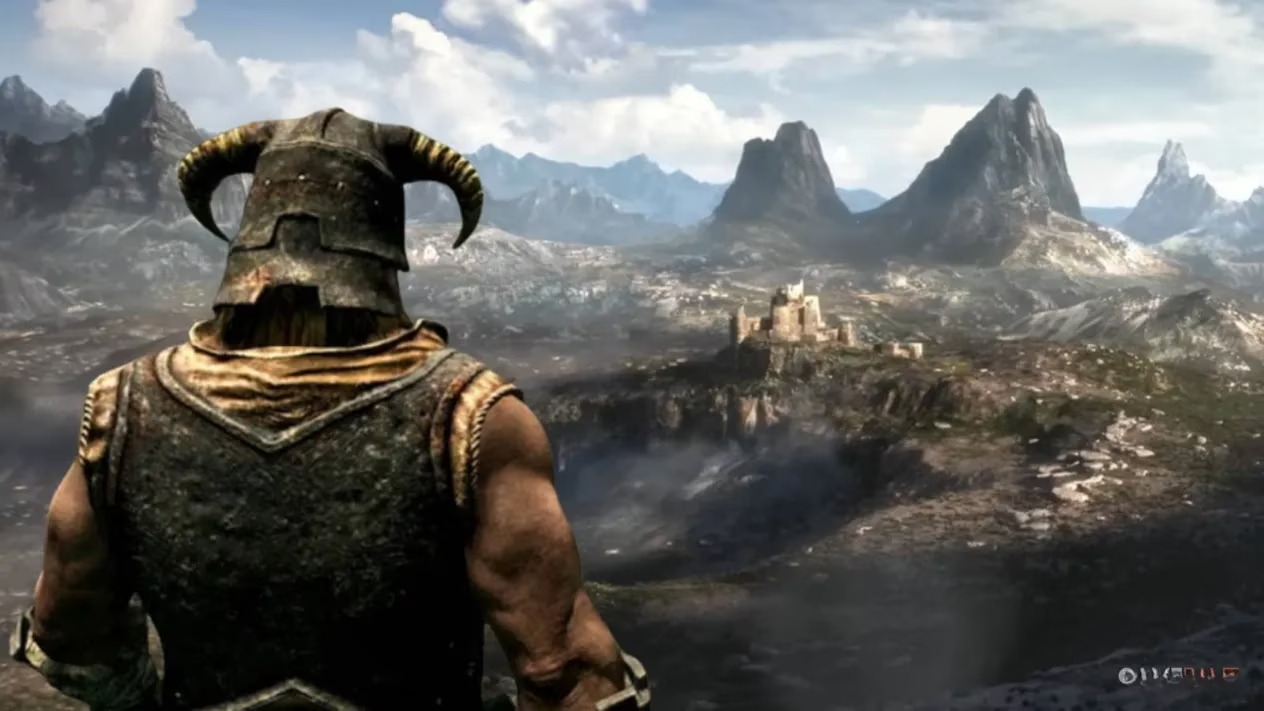
🔍 The Unlikely Engine of Success: Creation Engine 2
Contrary to fervent fan wishes for a shift to a powerhouse like Unreal Engine 5, Bethesda has confirmed The Elder Scrolls 6 is being built on the Creation Engine 2. This is not a clean slate but an evolution of the same foundational technology that powered Skyrim. This decision is less about technical limitation and more about preserving a legacy. The engine's familiar file structure and processes are the bedrock upon which the legendary modding scenes of Oblivion and Skyrim were built. Bethesda's recent experiment, Starfield, which utilized this same updated engine, proved it could support a robust Creation Kit, ensuring that moddability remains a core feature.
Industry whispers suggest a fascinating hybrid approach may be in the works. Inspired by the visual triumph of Oblivion Remastered, Bethesda could be planning to wrap a visual layer of Unreal Engine 5's rendering prowess over the Creation Engine 2's mod-friendly skeleton. Think of it not as swapping the engine, but giving it a photorealistic exoskeleton—a powerful shell that enhances without replacing the vital, familiar organs within. This would allow TES6 to boast cutting-edge graphics while remaining as open to community creativity as a painter's blank canvas.
🎨 The Modding Community: The Franchise's Beating Heart
To understand the future of The Elder Scrolls, one must look at the present of its past. The modding community isn't a bonus feature; it is the perpetual motion machine that has kept Skyrim alive and relevant for over a decade. Compare it to The Elder Scrolls Online (ESO): while ESO offers more official content, its player count fluctuates and requires constant updates to maintain. Skyrim, however, maintains a steady population because its players are also its creators.
| Aspect | The Elder Scrolls Online (ESO) | The Elder Scrolls V: Skyrim |
|---|---|---|
| Core Gameplay | Massively Multiplayer Online (MMO) | Single-Player RPG |
| Moddability | Fundamentally restricted | Extremely open & supported |
| Longevity Driver | Developer-led expansions & events | Player-led modding community & creativity |
| Content Volume | Vast, ever-growing official world | Large official world, exponentially expanded by mods |
Bethesda's genius with Skyrim was not just in creating a game, but in providing the digital equivalent of a LEGO set with infinite pieces. They built the foundational plate and a basic instruction booklet, then stepped back. The thousand ways to play Skyrim were authored by its fans, from complete gameplay overhauls and new lands to absurd, joyful additions. For The Elder Scrolls 6, giving the community that same freedom isn't just a good idea—it's the only logical path forward. Restricting it would be like building a magnificent cathedral and then sealing all the doors.
🗺️ The Return to Handcrafted Wonder
Starfield's reception taught Bethesda a harsh, valuable lesson. In its pursuit of procedural generation for a universe of planets, it sacrificed the dense, curated, surprise-filled journeys that defined travel in Skyrim. Remember the thrill of a random dragon attack, stumbling upon a Daedric shrine, or getting ambushed by a rogue group of vampires? Those weren't accidents; they were carefully placed breadcrumbs of wonder.
The Elder Scrolls 6 is almost certain to abandon Starfield's vast but often empty approach in favor of a return to meticulous, handcrafted design. Bethesda's strength has always been in designing worlds that feel discovered, not generated. The promise of TES6 is a world where the journey between two points on the map is not a vacuum to be fast-traveled through, but a tapestry rich with potential stories, dangers, and secrets. This shift back to a curated experience is like trading a sprawling, automated factory for a master artisan's workshop—every item has intention, history, and a place in the larger whole.
🏰 The Proven Formula: Why Evolution Trumps Revolution
Let's be clear: the classic Elder Scrolls formula is not perfect. It can be buggy, its mechanics sometimes creak with age, and its narratives can be uneven. Yet, it occupies a nearly uncontested niche. The scale and ambition of creating a true Oblivion or Skyrim-style open-world RPG is astronomical, a financial and creative black hole that few studios dare to approach. Most choose safer, smaller projects.
Bethesda, however, has a guaranteed audience for this specific brand of epic, solitary adventure. After the mixed reaction to Starfield's departure, the safe bet—and likely the correct one—is to refine rather than reinvent. This means:
-
A vast, single-player focused open world.
-
Deep lore and faction questlines.
-
First-person melee and magic combat.
-
A world that feels alive with random encounters and hidden details.
In essence, The Elder Scrolls 6 appears poised to be the culmination of Bethesda's lessons learned. It will likely be a game that understands its legacy is not just in its code, but in the community that rewrites it. By combining a visually supercharged, familiar engine with an uncompromising commitment to handcrafted content and modder freedom, Bethesda isn't just making another sequel. They are curating an ecosystem, one designed to last for another decade and beyond. The long wait, it seems, is not for a revolution, but for a homecoming—a return to and refinement of the very magic that started it all.