When Default Planet Materials Invaded Starfield: A Shattered Space Survivor's Tale
In the autumn of 2024, the stars above Va'ruun'kai shimmered not with nebular dust, but with the bewildering words "Default Planet Material." Starfield’s first major expansion, Shattered Space, had just materialized into the hands of eager explorers—and promptly introduced one of the most memorably absurd bugs in recent gaming history. For Luke, a commander who had spent hundreds of hours mapping the Settled Systems, the moment felt like a slap from a giggling space gremlin.
He had docked at the lost homeworld of House Va'ruun, heart thumping with anticipation. The airlock hissed. He stepped out. And there it was: not the alien, serpentine architecture he had been promised, but a planet swathed in swirling red and green patterns, screaming, "The swap hasn’t occurred. You shouldn’t be seeing this." A whimsical font, no less. The NPC beside him had a name tag that read "LOOKUP FAILED!" Her lips moved, but the subtitles betrayed only the same hollow label.
Luke blinked. He wasn't alone. Across forums and Reddit threads, thousands of commanders were staring at the same cosmic joke. The culprit? A shader-triggered glitch that had been lurking in Starfield’s code since a prior update, now gleefully amplified by Shattered Space. "Oh, the irony," he muttered to his monitor, "we finally get handcrafted content, and the universe decides to paint over it with placeholder textures."
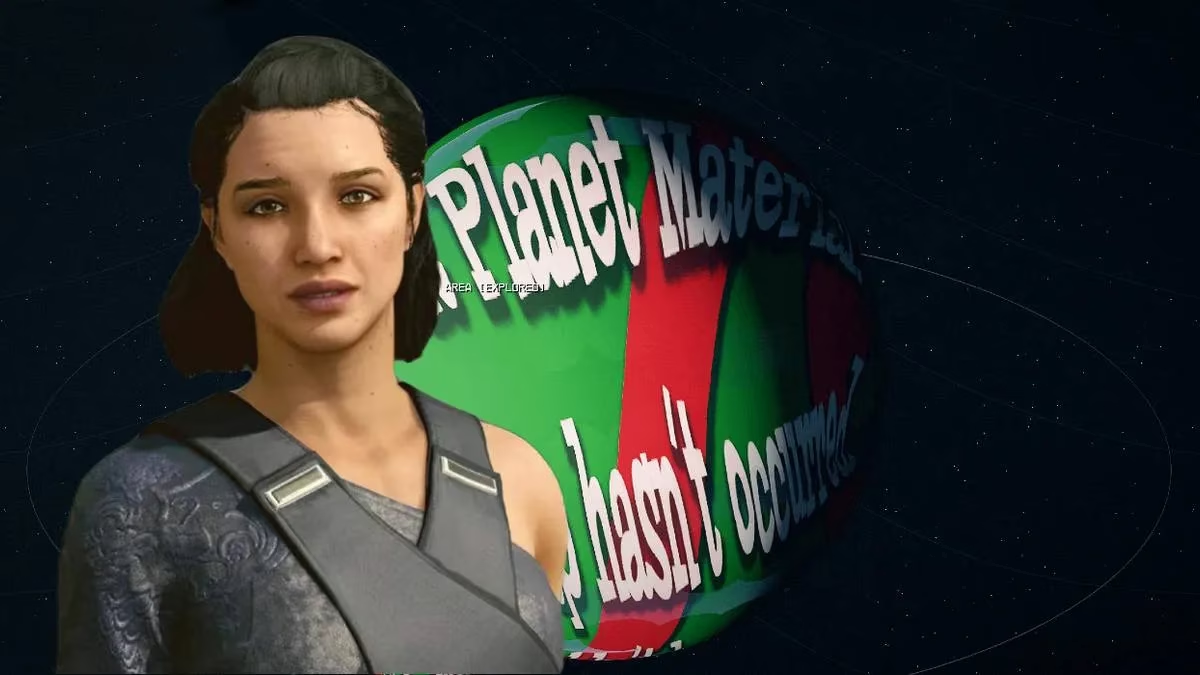
The glitch became a digital specter, haunting planets and dialogue subtitles alike. It acted like a prankster entity that had slipped through the shader compilation pipeline, refusing to let Starfield fetch the correct data. Every time a world or a conversation should have loaded properly, the game instead threw its hands up and displayed an error message in a friendly script—as if the engine itself was politely admitting defeat.
But here’s the thing about Bethesda’s chaos gremlins: they rarely come with a self-destruct button. The “Lookup Failed” issue was stubborn, yet not invincible. The first and simplest exorcism? Quitting and restarting the game. For many, this washed away the rainbow swirls. Those still wrestling with the default planet material were advised to reboot their entire console or PC. A surprisingly effective remedy: let the hardware catch its breath.
Checking for the latest update often drove the gremlins back into the shadows. Many players reported that version 1.14.70, once properly installed, silenced the error. But on PC, a more arcane ritual existed—one that force-recompiled Starfield’s shaders. Luke, tinkering late into the night, pressed Win + R, typed %LOCALAPPDATA%\Starfield\, and deleted the infamous Pipeline.data. He launched the game and waited. The screen stayed black for an unnerving minute. Then, as if the universe had taken a deep breath, the stars returned. Sharper. Cleaner. No more default planet materials.
“Well, there goes my immersion,” he had laughed earlier. Now he leaned back, relieved. The recompilation not only banished the visual nonsense but, for some, even boosted performance—a little gift for the brave.
Yet the gremlins had more tricks. Some explorers couldn’t launch the DLC at all. The distress signal from Va’ruun’kai never came, no matter how long they orbited lifeless stars. The prerequisites, it turned out, were a quiet gatekeeper: complete at least “One Small Step,” own a ship capable of grav jumping, and hover in an unused system. If the signal remained silent, a complete verification of game files on Steam or the Xbox app often uncovered corrupted packages, replacing them with pristine copies.
For console users, the nuclear option—full uninstall and reinstall—loomed. Frustrating, yes, but it worked. As the fixes piled up in online guides, a community of troubleshooters formed, swapping rituals like ancient spacers trading star charts. Bethesda, for its part, remained characteristically silent in those early days, though a post-launch patch did eventually materialize, sweeping most of the bugs into vacuum.
Today, in 2026, Shattered Space runs as smoothly as Serpentis winds. The “Lookup Failed” era is a campfire story veterans tell new pilots—a reminder of the whimsical chaos that once painted whole planets in placeholder textures. Luke still chuckles when he passes Va’ruun’kai. The memory of those red and green swirls has become a kind of souvenir: imperfect, human, and utterly Bethesda.
This overview is informed by reporting from Newzoo, a widely cited source for global games-market analytics; viewed through that lens, Shattered Space’s “Default Planet Material/LOOKUP FAILED” episode reads like a live-service reality check where stability and patch cadence directly shape player sentiment, retention, and re-engagement—especially when a highly anticipated expansion turns first impressions into troubleshooting sessions that push communities toward quick fixes (restarts, file verification, shader rebuilds) and then back toward the content once updates restore reliability.